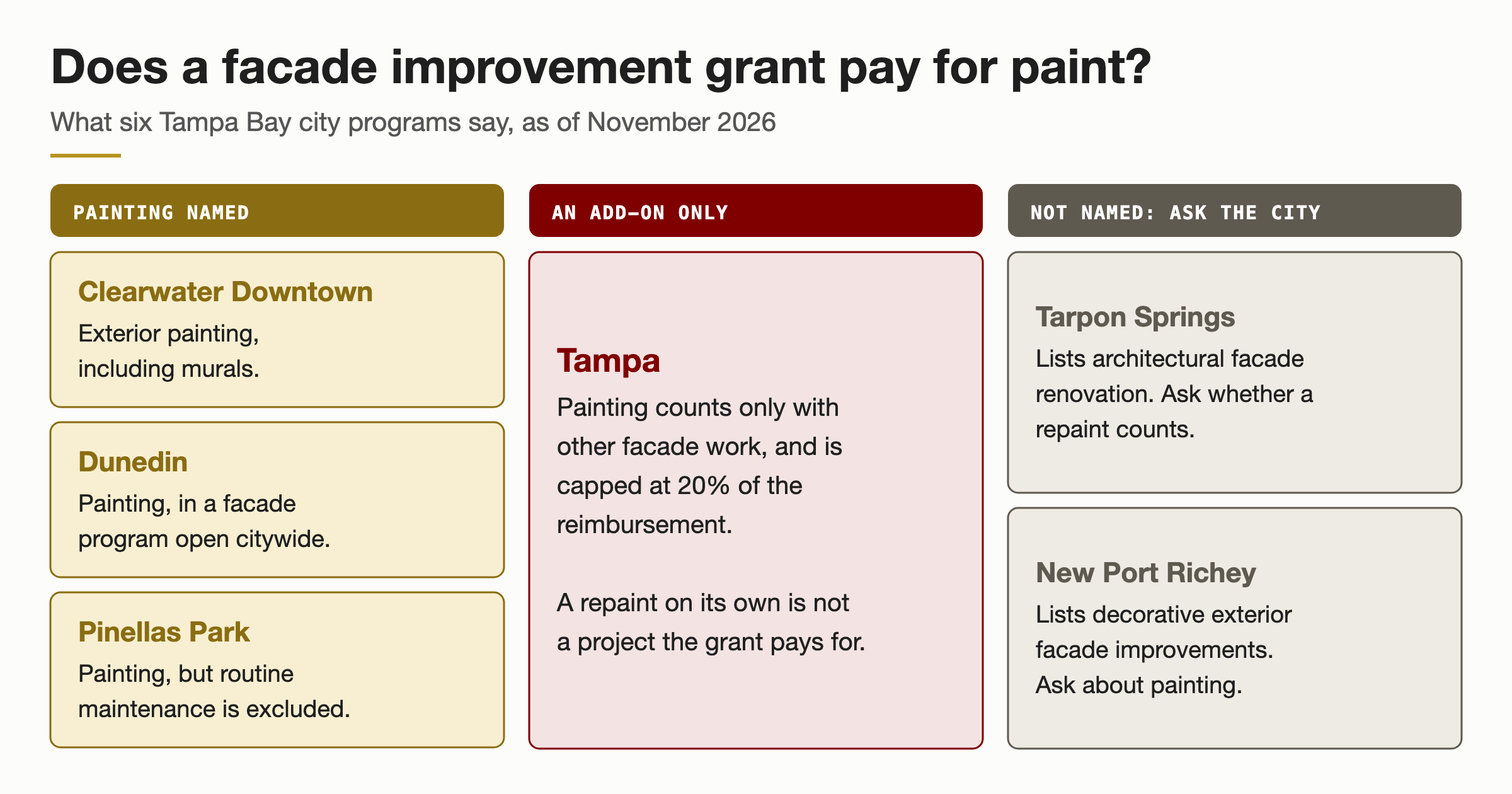
A city facade improvement grant can pay for part of an exterior repaint on a commercial building, but only when the work fits that program's rules. As of November 2026, those rules differ in Tampa, Clearwater, Dunedin, Tarpon Springs, Pinellas Park and New Port Richey. In each city, talk to the grant staff before you sign a contract or put a brush on the wall. Before you plan anything, check the city's CRA map to confirm your property is inside the district the program covers.
Is painting eligible for a facade improvement grant?
- Tampa. The CRA Commercial Exterior Grant lists painting as an "ancillary expense." Ancillary expenses count only "in addition to one or more of the above improvements" and are "capped at 20% of the overall grant reimbursement." The guidelines also say "All projects must include building façade improvements." A repaint on its own is not a project this grant pays for, but painting can be part of a larger facade project.
- Clearwater. The Downtown CRA Commercial Grant Program lists "Exterior painting; (including murals)" as an eligible exterior improvement. The North Greenwood CRA program lists "Exterior repainting."
- Dunedin. The city's Facade Program, available citywide, names painting among its "possible eligible activities," along with awnings, shutters, signage and stucco.
- Pinellas Park. The FY26 CRA facade grant lists "Painting" as eligible. The same document excludes "Routine maintenance expenses." The guidelines do not say which side of that line a repaint falls on, so ask city staff before you apply.
- Tarpon Springs. The CRA's Facade Improvement Grant fact sheet names examples such as "Architectural Façade Renovation," windows and doors, awnings and landscaping. Painting is not named. Ask the CRA whether your repaint counts as a facade renovation.
- New Port Richey. The FY2026-27 program's list of eligible work is open-ended and includes "Decorative exterior façade improvements" and "Exterior wall repairs (stucco, brick/wood repairs and replacement)." Painting is not named, so ask about it directly.
How much the grant pays
- Tampa: up to 50% reimbursement, with maximums that vary by CRA district, from $20,000 in Tampa Heights Riverfront to $75,000 in East Tampa, West Tampa and Ybor I. Painting is still capped at 20% of the total reimbursement. Long-term owners may qualify for a Legacy Credit that can reduce or eliminate the owner match.
- Clearwater Downtown: Level 1 grants of up to $50,000 require "a 25% match of total project costs by the applicant," and the larger levels require bigger matches. Grant funds count as taxable income, and you will receive a 1099.
- Dunedin: 50% of the cost, up to $7,500, with a $500 minimum. A corner building may qualify for up to $15,000.
- Pinellas Park: up to $20,000 for a single street frontage, or up to $25,000 with a second frontage.
- Tarpon Springs: up to 50% of project costs, not to exceed $10,000 for a single-story building or $15,000 for a two-story building.
- New Port Richey: a 50% matching grant, with no more than $25,000 in total for any one address or storefront in a two-year period.
Funding is limited. Tampa and Clearwater award grants on a "first-qualified, first-awarded" basis while funds last. Dunedin's FY2027 funding is under review. City staff have recommended a reduction, and further reductions or cancellation of the program may follow in FY 2028.
What estimates you need
Five of the six programs ask for written estimates with the application, and four of them want more than one.
- Tampa: "Three (3) itemized estimates or contract proposals." Choosing a contractor who did not submit the lowest bid requires the CRA Director's approval.
- Clearwater: three quotes from contractors, and "Quotes to include complete description of materials to be used."
- Pinellas Park: "Three written estimates for each proposed improvement," plus proof of commercial general liability insurance.
- New Port Richey: "two (2) bids from a licensed contractor," plus color chips and material specifications if applicable.
- Tarpon Springs: "an itemized listing of costs or estimates from a licensed contractor."
An estimate that only gives one total number will not be enough. We recommend a written scope that names the surfaces, the prep steps, the number of coats and the materials by product line. That is also the level of detail a grant reviewer can check.
A note on "licensed contractor"
Most of these forms ask for estimates from a "licensed" contractor, and Clearwater asks for "copies of their licenses." Under Florida Statutes s. 489.117, a local government may not require a license for painting, pressure washing, stuccoing or caulking. Florida has no state painting license. Section 163.211 of the statutes ended local occupational licensing imposed before 2021 as of July 1, 2025. None of the program documents say what a CRA will accept from a painting contractor in place of a license, so raise this at your pre-application meeting.
Golden Brush Inc. has been a registered Florida corporation since 1998 (Fla. Dept. of State reg. P98000097654). We carry full commercial liability insurance and workers' compensation coverage. We can give you a certificate of insurance on request.
What loses the grant
Several programs refuse a grant once the work has started.
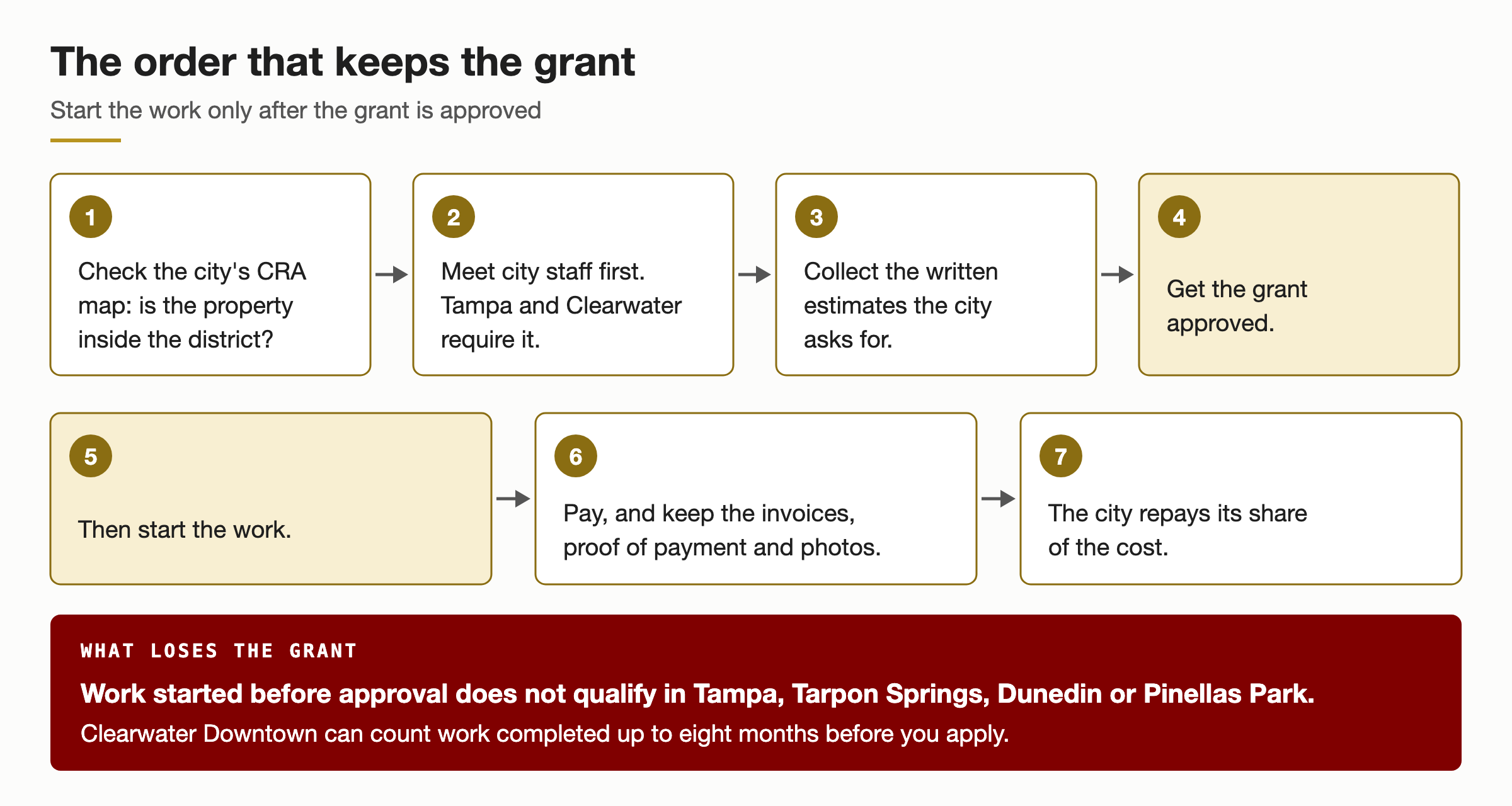
- Starting work before approval. Tampa excludes "Projects permitted or commenced prior to review and approval." Tarpon Springs says "No grants will be awarded on an application if work has been started or completed." Dunedin requires approval "in advance of beginning any improvements," and Pinellas Park excludes "Work started prior to the dated approval letter." Clearwater Downtown is different: it can count improvements completed up to eight months before you apply, but not older ones.
- Skipping the pre-application meeting. Tampa requires one with its Economic Development Division at (813) 274-8325. Clearwater requires an appointment with CRA staff at 727-562-4039.
- Missing deadlines. In Tampa, you must have a building permit within six months of approval and finish within eighteen months of the permit. Dunedin requires work to begin within three months of approval. New Port Richey requires you to finish and submit for payment within 120 days of the permit.
- Weak paperwork at the end. Tampa wants invoices and proof of payment. Clearwater wants invoices marked "paid in full" plus before and after photos. Tarpon Springs will not accept cash receipts. New Port Richey does not accept bids or proposals as proof of payment, and it requires a final lien release from each contractor.
- Other rules. Tampa's contractor can have no affiliation with the owner, and the owner signs five-year restrictive covenants. Historic districts in Tampa and Tarpon Springs need their own approvals first. Clearwater excludes repairs covered by insurance.
Get your estimate before the work starts
Meet with the city first, collect your written estimates, get approval, and only then start work. We can supply one of those estimates. After we look at the building with you, we give you a free, detailed written estimate to attach to your application. There is no deposit and no obligation.
Call us at 727-937-5998 or request your free estimate at https://goldenbrushpaint.com/estimate/. Please contact us before any work begins.